Every guide to going out in this city opens the same way. A rooftop. A view. Somebody holding a glass. And a price that would make your eyes water in London, never mind here.
That is one evening in Kuala Lumpur. It is not the evening most people here are having.
I’ll tell you what a normal night out actually looks like, because I’ve been doing them for two years and I’ve yet to have one on a roof.
It goes dark at seven, every night, forever
We’re near the equator. Twelve hours of light, twelve hours of dark, all year round.
There are no long summer evenings here, and there’s no winter afternoon that’s finished by four. It gets dark at seven in January and it gets dark at seven in June.
Which means the evening starts at the same time every single day of your life, and the whole city is built round that. Nothing here is about making the most of the light. Everything opens up after dark, because after dark is when it’s finally bearable to be outside.
The night markets are the main event, not the cheap option
A night market — a pasar malam — is where I’d take you first.
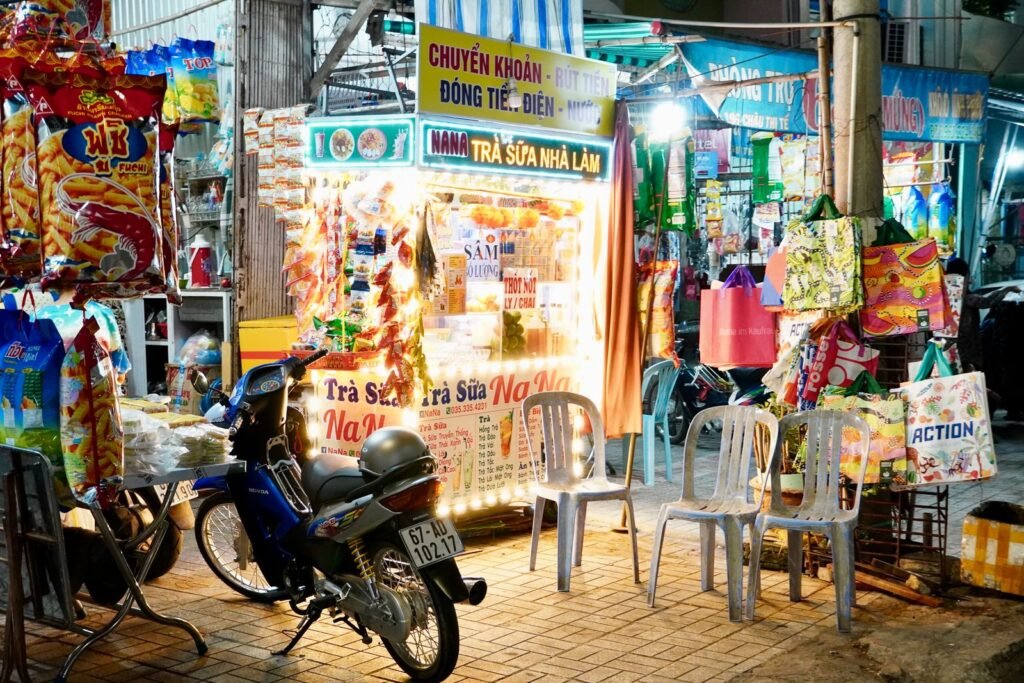
Stalls down a street. Food cooked in front of you. Noise. Families out with the kids at nine at night. Old boys sat at plastic tables who’ve been there since six and are in no rush to leave. The whole thing running on into the evening in a way no British high street has managed in my lifetime.
You walk about, you eat, you look at things, and then you eat again.
And here’s the number that reframes it: eating out here is roughly five times cheaper than Britain. A meal that would be fifty quid at home is nearer a tenner. A plate of nasi lemak is about RM5 — call it a pound.
So a proper evening out, fed and entertained, costs about what one round of drinks costs in a British pub.
Restaurants, and the thing about "going for a Chinese"
In Britain, a cuisine is an occasion. You go for a Chinese, or you go for an Indian, and it’s an evening thing. You do it once, at night, and that’s the whole relationship you have with it.
Here it isn’t a cuisine. It’s just food.
There’s a breakfast version, a lunch version and a dinner version of everything — Chinese, Indian, Thai, Korean, Malay — because to the people eating it, none of it is foreign.
What that means for you: there is always somewhere properly good, properly open, properly late. Not a takeaway hanging on till midnight. A full restaurant with people in it.
The question round here is never "where shall we eat?" It’s "what do you fancy?" — and the answer is about ten minutes’ walk from wherever you’re stood.
The malls are not what you’re picturing
A British reader hears mall and thinks of a half-dead shopping centre with a phone repair kiosk in the middle.
Malaysia has a serious mall culture, and the malls here are where people actually go of an evening. Not just to shop. To eat, to meet people, to sit in the air conditioning and be out of the house.
Whole floors of restaurants — proper ones, not a food court with a soggy chips counter. Air conditioning, which after a day at thirty-two degrees is not a small thing. Cinemas, places for kids, places for old people, everyone in at once.
Ours is still The Curve, which was the mall next door to the hotel we stayed in for our first fortnight in the country. We moved away a long time ago and we still get a taxi back to it. Two years on. That tells you how much of your life a mall can end up being here.
Getting there, and getting home
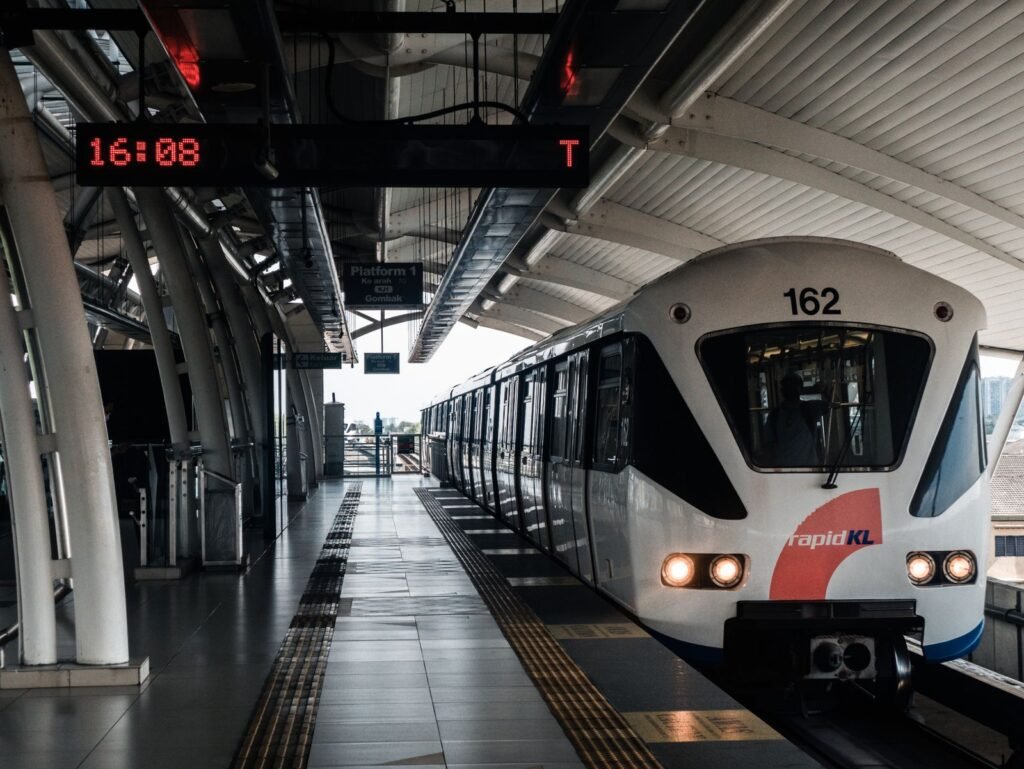
The trains are better than the London Underground, and I’ll say it in print. Cleaner, less crowded, air conditioned — and in this heat that last one isn’t a luxury, it’s the whole thing.
And where the train doesn’t go, Grab is a fraction of what a British taxi costs. At home you’d think twice about a cab back. Here you don’t.
Which is the real reason a night out here is easy: getting home isn’t the expensive, annoying part of the evening.
And if you want a drink
You can have one. Bars, rooftops, restaurants that serve it — it’s all here and none of it is hidden.
One thing to know before you order: alcohol is taxed hard in Malaysia and it’s expensive. Roughly five times what you’d pay in Britain. A bottle of gin that’s about a fiver in a British supermarket is nearer £25 here.
So it’s the exact opposite of home. In England the food is dear and the drink is cheap. Here the food is cheap and the drink is dear.
That’s the whole of what I’ve got to say about it. Have one if you fancy one — just don’t build the night around it the way you might at home, because it’s the one thing in this city that costs more than it does in Britain, and everything else costs less.
What I’d actually do with your evening
Eat first, properly, somewhere busy. Busy is the only review that matters here.
Then walk. The city is lit up and the temperature has finally dropped to something a British person can stand. This is the bit the rooftop guides can’t sell you, because it’s free.
Then something sweet, because everyone else is having something sweet.
And then home on the train, which will be cleaner than the one you got to work on last week.
Nobody’s watching what’s in your glass and nobody’s counting. Kuala Lumpur is a city where an enormous number of people are out until eleven at night with their whole family, eating, talking and having a completely brilliant time.
Turn up hungry. The rest sorts itself out.