Some links on this site are affiliate links. If you buy through them I get a small commission at no cost to you. Nothing here is recommended unless I’d genuinely recommend it.
I opened the electricity bill with the specific face you make when you already know the answer and you don’t like it.
We’d been late paying. Four months had piled up. Four months of living on the 34th floor of a tower block in a country that sits about two degrees off the equator and has never once, in recorded history, been described as “a bit nippy”.
I’d mentally set aside a thousand pounds. I thought I was being optimistic.
It was seventy quid.
Seventy pounds. Four months. I checked it three times, then made my wife check it, then briefly wondered whether we’d been stealing electricity from the flat next door by accident.
We hadn’t. We’d just stumbled onto something that almost every British expat here gets spectacularly wrong, and I’m going to tell you what it is, because it’s the single easiest money you will ever save in this country.
The mistake everyone makes
You arrive from Britain. It is thirty-two degrees and the air has the consistency of soup. You walk into your new flat, you find the air conditioning remote, and you treat it like the central heating you left behind — on in the morning, off when you go out, on again when you get back, and absolutely blasting all night.
That’s the British instinct. Heating is something you leave running. So you run the aircon the same way.
And then your bill arrives and you tell everyone back home that Malaysia isn’t as cheap as people say.
It is. You’re just paying to refrigerate a room you’re not sitting in.
What we actually do
Here’s the whole method. It’s not complicated. That’s rather the point.
The air conditioning goes on for about ten minutes a day. That’s it. Ten minutes.
Modern aircon in a small flat is brutally effective — it doesn’t gently coax a room down to a pleasant temperature, it drops it like a stone. Ten minutes and the place is genuinely cold. Then off it goes.
Then the ceiling fans run constantly. Day and night. They only go off when both of us are out of the flat, and even then I sometimes leave them going because I can’t be bothered.
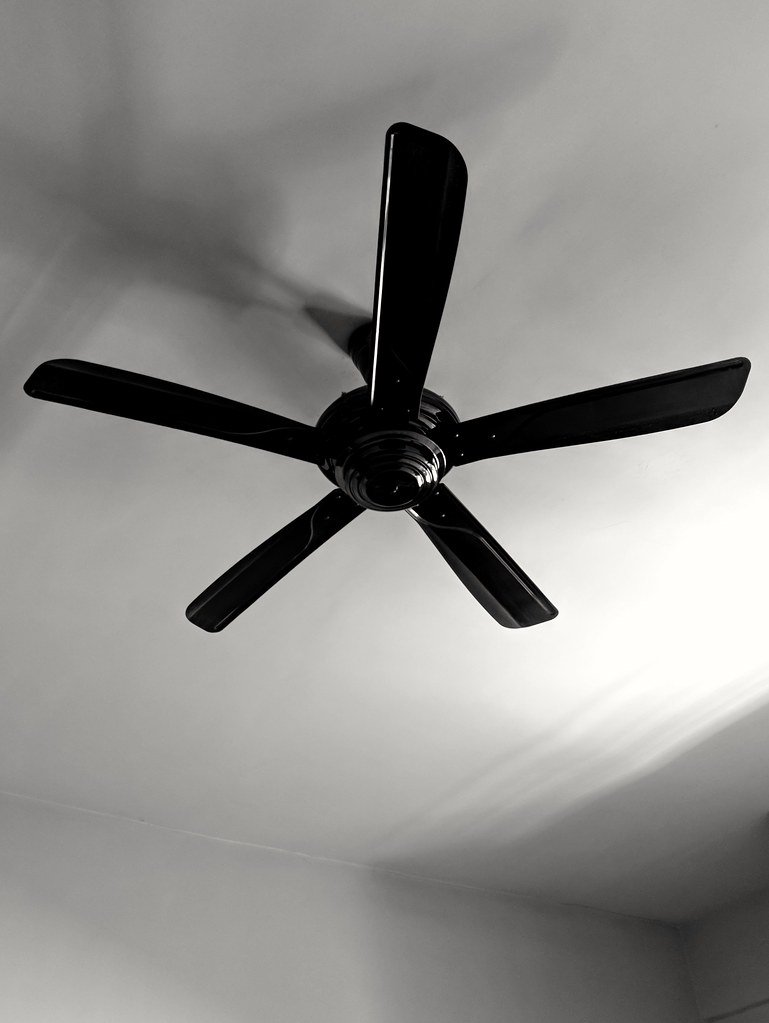
Our fans are enormous. I’ve called them helicopter propellers so often my wife has stopped acknowledging it. But that’s the job they’re doing: keeping the cool air moving so it never has a chance to sit still and turn back into soup.
Aircon to cool the room. Fans to keep it cool. That’s the entire trick, and it’s why our bills read like a printing error.
Why it works, in numbers
This isn’t folklore, it’s just how the appliances draw power.
A ceiling fan pulls something in the region of 50 to 75 watts. A domestic air conditioning unit pulls a thousand watts and upwards, and considerably more while it’s working hard to drag a hot room down.
So you can run a ceiling fan for hours for roughly what the aircon costs you in minutes. Run four fans all day and you’re still nowhere near the cost of leaving one aircon unit on overnight.
For reference, domestic electricity here runs at roughly 27 sen a unit before rebates, and lower-usage households get a rebate on top of that. Which is to say: cheap, unless you’re actively trying not to be.
Here’s the bit nobody mentions, though. A fan doesn’t cool a room at all. It cools you — moving air across your skin so sweat evaporates faster. Which is why a fan in an empty room is genuinely pointless, and a fan pointed at a sweating Englishman is the best value in Southeast Asia.
The things that actually took us a while to learn
Don’t set the aircon to sixteen degrees. It doesn’t cool faster, it just runs longer and harder before it stops. Twenty-four is plenty, and you won’t wake up at four in the morning wondering why you can see your own breath in Malaysia.
Shut the curtains during the day. Especially if you’re high up with big windows, which in KL you probably are. Sunlight coming through glass is a heater you didn’t ask for.
Clean the aircon filters. A clogged unit works harder for a worse result. Ours get done every couple of months and it makes a noticeable difference.
Don’t dry washing indoors with the aircon on. You are paying good money to remove water from the air while simultaneously adding water to the air. I did this for weeks before the penny dropped.
Pay the bill on time, unlike some people I could mention, so you’re not opening four months at once with your eyes half shut.
What this means for your budget
Most cost-of-living guides for Kuala Lumpur will tell you to set aside a few hundred ringgit a month for electricity. That’s a perfectly sensible figure — for someone running aircon the British way.
Do it the fan way and it becomes a rounding error. Ours is comfortably the smallest line in the monthly budget, sitting somewhere below the internet bill and a long way below the weekly shop.
If you want the full picture of what everything else costs out here, I’ve done an honest breakdown of the lot, and there’s a calculator that compares it directly to what you’re paying in the UK. Fair warning: the food numbers are more fun than the alcohol numbers.
One last thing
When you’re viewing flats, look up.
Check there are proper ceiling fans in the bedroom and the living room, and that they’re real ones rather than a decorative afterthought with three plastic blades and the airflow of a disappointed sigh. It’s not the sort of thing you think to check when you’re being shown a pool and a gym and a view. It should be.
Ours were already there when we moved in, which means the seventy-pound bill wasn’t clever planning on my part. It was luck, followed some months later by working out why.
If your place hasn’t got decent ceiling fans, this is the one thing worth buying rather than waiting for a landlord to sort. Standing fans and decent ceiling fans are everywhere on Shopee for a fraction of what the same thing costs in Britain, and it pays for itself in about a fortnight of not running the aircon.
That’s most of expat life, in fairness. Getting away with something and then reverse-engineering the reason.
More on the practical side of setting up here: renting a flat in KL and the honest guide to moving over from Britain.
FACTS CHECKED
✓ £70 equivalent across four months, with minimal aircon use — Edward’s own bill
✓ Ceiling fan power draw typically 50–75W; domestic aircon typically 1,000W+ — standard appliance figures
✓ Fans cool people, not rooms, by aiding evaporation — basic physics, widely documented
✓ Malaysian domestic electricity roughly 27 sen/kWh before rebates, with tiered rebates for lower-usage households (tariff restructured July 2025) — TNB
⚠ Exact ringgit figure for the four-month bill not quoted — converted approximate only
⚠ Tariffs change. Correct at time of writing, August 2026.
⚠ Aircon filter cleaning interval is Edward’s own habit, not a manufacturer specification.
That bill sits alongside all the others on my running price list, if you want the full picture.