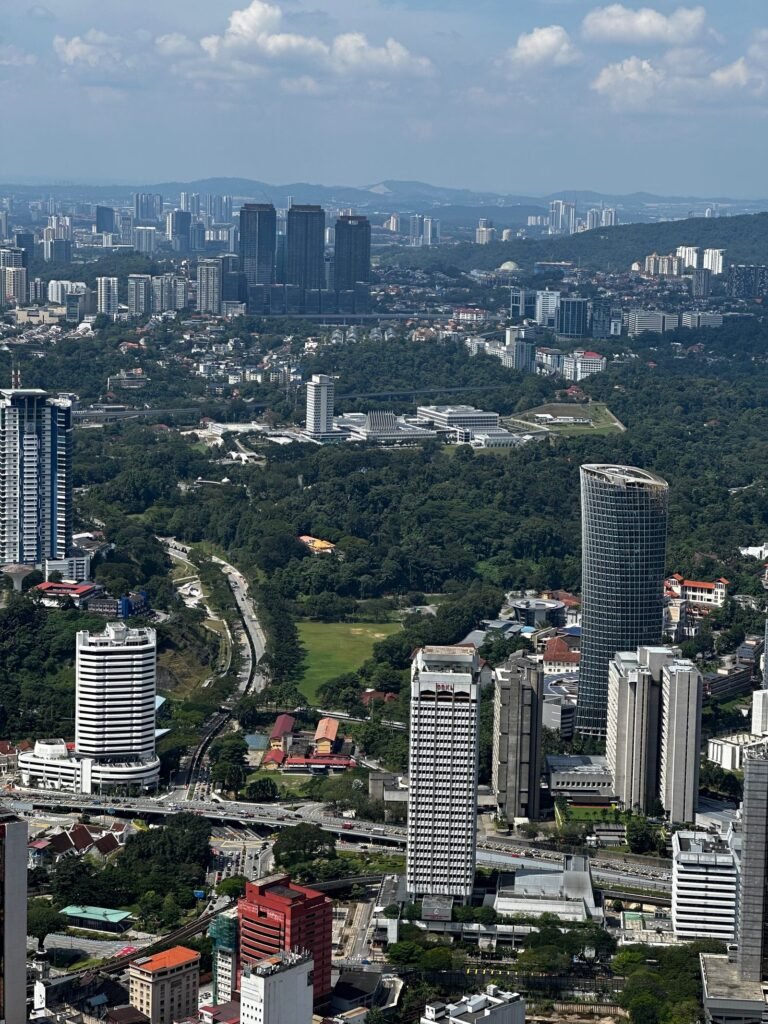
We walked out of the airport at the same moment, into the same air, and had two completely different experiences.
Jacqueline: it’s too hot. Unbearable.
Me: oh, that’s lovely, that.
Same minute. Same pavement. Same temperature to the decimal place. One of us wanted to go home and the other one was thinking about whether he could get away with shorts.
Every article about the heat in Malaysia is written by one confident person telling you what it’s like. I live with the counter-argument. So this one comes in two voices, and I’d suggest that’s more use to you than either of us on our own.
| Stage | Him | Her |
|---|---|---|
| Stepping off the plane | Toasty. Loved it immediately. | Unbearable. Too hot. |
| The first month | Fine, honestly | Not fine |
| Now | Doesn’t notice it | Doesn’t notice it |
That last row is the whole point of the post, so hold on to it.
What the numbers actually are
Let’s do the facts before the jokes, because you’ve probably come here to find out whether you can cope and not to hear about my marriage.
Kuala Lumpur does not have seasons in the way Britain has seasons. It has weather, all year, and the weather is broadly the same weather.
- Daytime highs run about 31–32°C, every month of the year. The very hottest stretch is roughly March to June. The mildest is around November and December, and “mildest” is doing an enormous amount of work in that sentence.
- Night-time lows sit around 22–24°C. There is no cool evening. There is no relief at midnight. The night is just the day with the lights off.
- Humidity averages around 80% across the year. This is the bit that gets British people, not the temperature. Thirty-one degrees in Spain and thirty-one degrees here are not the same event.
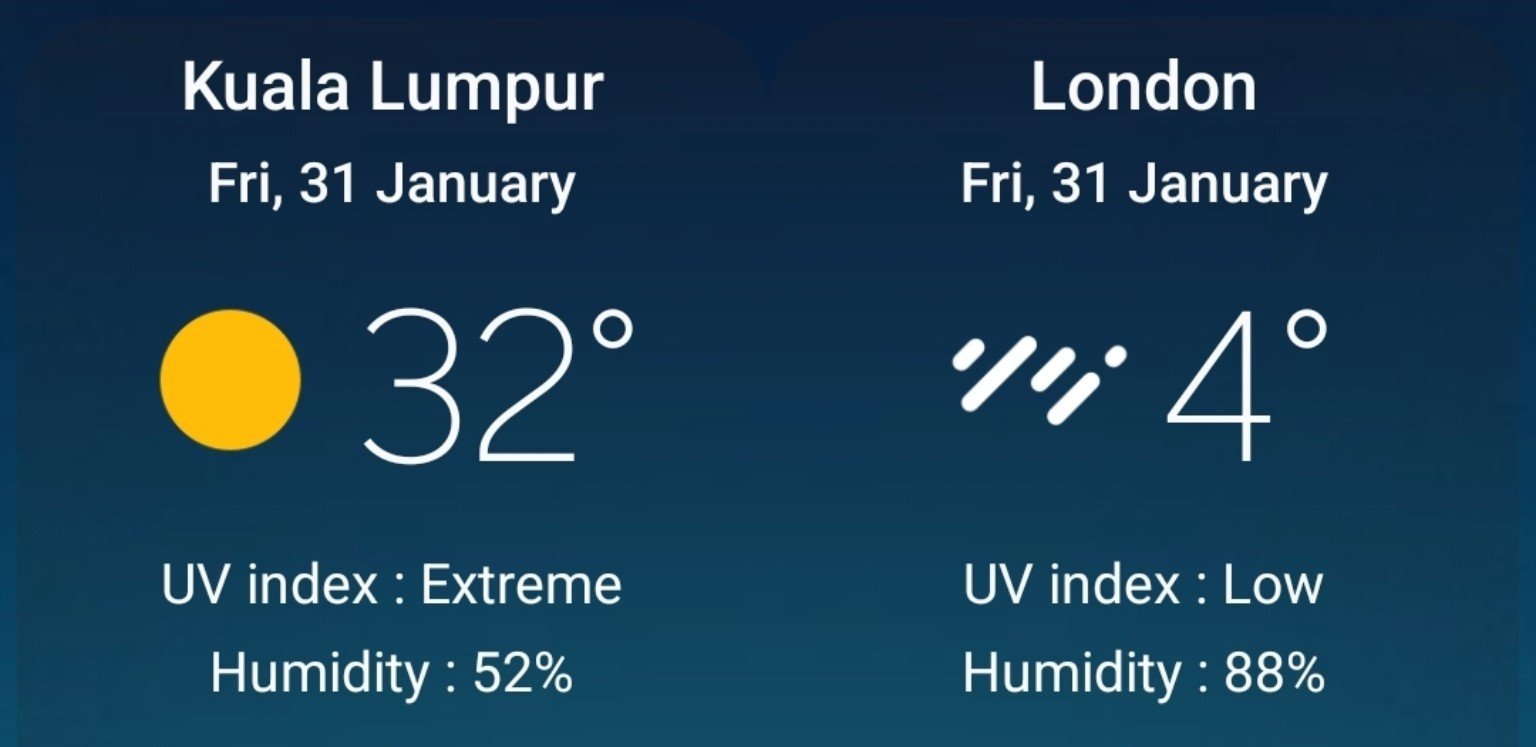
We landed in January, which is supposedly the cooler end of the calendar. It was about 28 degrees. In their cool season. I’d come from an English January, where 28 degrees would be a national news story and three people would faint on a train.
And it goes dark at seven. Every single day. Forever.
Nobody warns you about this one and it catches everybody.
Kuala Lumpur sits about three degrees north of the equator. That means the day is roughly twelve hours long and the night is roughly twelve hours long, all year round. The longest day of the year here is about 12 hours 12 minutes. The shortest is about 11 hours 48. A total swing of twenty-four minutes between midsummer and midwinter.
There is no long summer evening. There is no light at nine o’clock in July while you’re stood in a beer garden pretending you’re not cold. It gets dark at seven, and then it gets dark at seven tomorrow, and it will get dark at seven for the rest of your life.
Also, and connected: it’s dark at seven in the morning too. I walked my wife to work at 7am for her first full year here, and we set off in the dark every time. Near the equator there’s barely a dawn to speak of. The sun doesn’t rise so much as arrive.
How long until you stop noticing
Here’s the good news, and it’s better news than most people expect.
In my experience it took somewhere between two weeks and two months. Not “you’ll never get used to it.” Not years. Weeks.
That squares with what the research says, for what it’s worth — the body’s adaptation to heat mostly happens over about ten to fourteen days of regular exposure. Your blood volume goes up, you start sweating earlier and more efficiently, your resting temperature and heart rate come down. It’s a real physiological process, not a matter of attitude, and it happens whether you’re cheerful about it or not.
The humid part is genuinely harder to adapt to than the hot part, because when the air is already 80% full of water your sweat has nowhere to go. That’s not you being weak. That’s physics being unhelpful.
And now? Years in?
Neither of us notices it at all. Not Jacqueline, who wanted to get straight back on the plane. Not me. Acclimatised twenty times over. The woman who found it unbearable now walks around in it without comment, and if you’d told her that in week one she’d have thrown something at you.
The bit that actually saves you money — fans, not aircon
This is the most useful paragraph on this page, so if you’ve been skim-reading, stop.
Everybody arrives and does the same thing: puts the air conditioning on and leaves it on. Then the bill comes and they have a small private crisis in the kitchen.
Here’s what we do instead.
The aircon goes on for about ten minutes a day. That’s it. It’s powerful enough to drop the room temperature fast — that’s what it’s for. It’s a cooler, not a thermostat.
Then the ceiling fans do everything else. Ours are enormous, like helicopter propellers, and they run constantly, day and night. They only go off when both of us leave the flat.
Aircon to get cool. Fans to stay cool. That’s the entire trick, and most expats never work it out.
Our electricity bill for four months came to well under a hundred pounds — and we’d paid it late, so I opened it braced for something near a thousand. I stood there reading it twice. With barely any air conditioning used at all.
I’m not putting an exact figure on that because it’s our flat, our habits and our building, and yours will be different. But the direction of travel is not subtle. What I can put numbers on is on the price page, straight off my own bills.
Practical things that are actually true
- The trains are air-conditioned and they’re everywhere. You do not need a car in this city. Between the LRT, the MRT and the monorail you can get about the place in cold air for very little.
- The malls are the air conditioning. Malaysia has a serious mall culture and part of the reason is obvious the moment you walk into one. They’re not just shops. They’re the public living room, and they’re free, and they’re freezing.
- Carry a layer for indoors, not outdoors. This is the joke that gets every Brit. You will be too hot in the street and genuinely cold in a restaurant. I have seen people put a jumper on to eat lunch in a tropical country.
- The rain is not English rain. When it comes down it properly comes down, and then it stops. It’s not a grey drizzle that lasts a fortnight.
- Drink more water than feels reasonable. Unglamorous, boring, and the single biggest difference between your first week being fine and your first week being awful.
The line that sums up the whole thing
In England, somebody’s always shouting “close the door, you’re letting the heat out.”
Here I’m shouting “close the door, you’re letting the heat in.”
Same sentence. Same irritation. Opposite direction. My family have got the heating on and I’ve got the aircon on and we’re both stood there defending our own air, thousands of miles apart.
You’ll get used to it faster than you think. Everyone does. Even the person who stood on the pavement at the airport and told me she wanted to go home.