Thaipusam is one of the most extraordinary things you can witness in Southeast Asia — and it happens every year in Malaysia, free to attend, fully accessible to anyone who wants to see it. If you’re living in or visiting KL and Thaipusam falls during your time here, don’t miss it.
The short description: it’s a Hindu festival observed by Tamil communities, marked by acts of devotion and ritual piercing — devotees carry ornate structures called kavadi on their bodies, often attached through skewers and hooks, in a state of spiritual trance. The procession from KL to Batu Caves draws over a million people over a single night and day. It is one of the largest single-day gatherings in Malaysia and one of the most visually and spiritually intense events I’ve ever attended.
Here’s what Thaipusam is about, what to expect, how to get there, and how to be a respectful observer.
What Is Thaipusam?
Thaipusam is a Hindu festival celebrated mainly by Tamil communities. It honours the Hindu deity Murugan (also known as Subramaniam or Kartikeya), the son of Shiva, and falls on the full moon of the Tamil month of Thai — typically January or February in the Gregorian calendar.
The festival involves devotees fulfilling vows made to Lord Murugan, often in thanks for a prayer answered or a wish fulfilled. The most visible form of devotion is the kavadi attam — carrying a physical burden (the kavadi) to Murugan’s shrine. The most elaborate kavadis are huge arched structures decorated with peacock feathers and flowers, attached to the devotee’s body through metal skewers that pierce the skin and cheeks. Smaller acts of devotion include milk pots (pal kudam) carried on the head.
Devotees prepare for weeks or months before Thaipusam — fasting, prayer, and meditation to achieve a state of spiritual purity and trance during which the piercing is performed. Supporters and family members walk alongside, singing and chanting. The atmosphere is one of intense religious devotion, not performance — what you’re witnessing is genuine.
Thaipusam at Batu Caves
Malaysia has the largest Thaipusam celebration outside India, and the main site is Batu Caves, 13km north of KL. The festival begins with a procession from the Sri Mahamariamman Temple in Chinatown through the streets of KL to Batu Caves — a journey that takes many hours to complete and is covered by devotees on foot through the night.
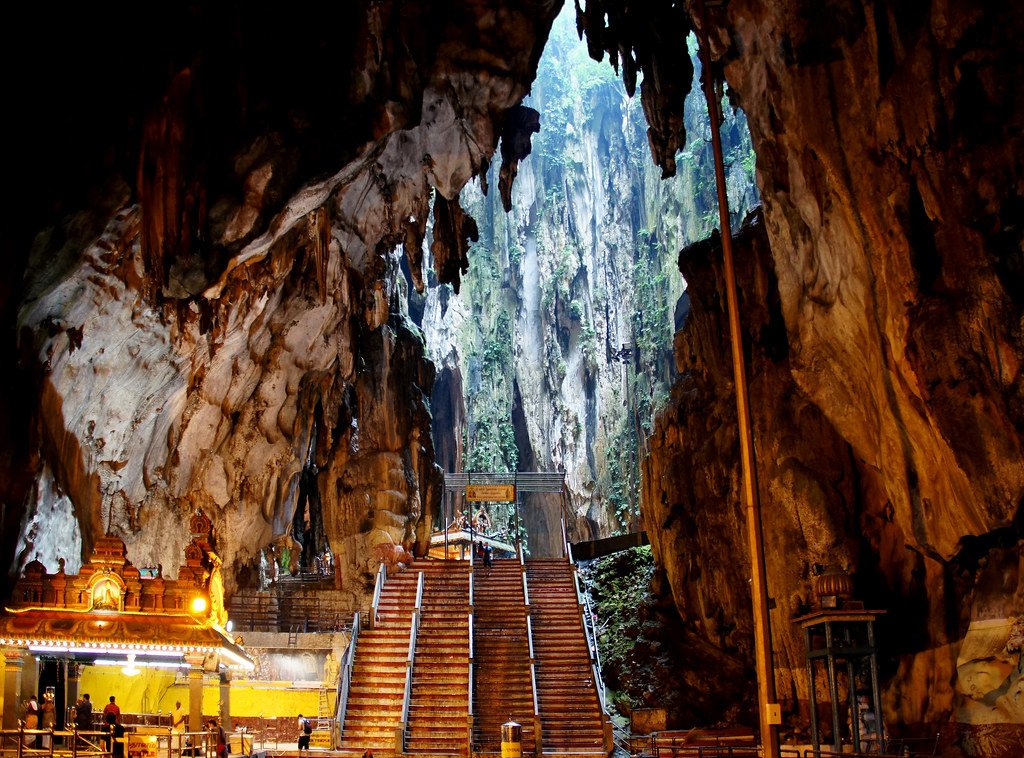
At Batu Caves, devotees climb the famous 272 steps to the main cave temple to present their kavadis to the shrine of Murugan. The golden statue of Lord Murugan at the cave entrance (the tallest in the world at 42.7 metres) is particularly dramatic on Thaipusam, flanked by thousands of devotees, music, chanting, and the smell of incense.
The crowd peaks in the early morning hours of Thaipusam day and continues through the morning. By afternoon, numbers begin to thin. The full event spans roughly 24 hours.
When Does Thaipusam Fall?
Thaipusam follows the Hindu calendar. In 2025 it fell on February 11th. In 2026 it falls on January 31st. Check the official dates each year as they vary. It is a public holiday in Kuala Lumpur, Selangor, Johor, and Penang — though not a federal public holiday, so it depends on which state you’re in.
What to Expect at Batu Caves During Thaipusam
The crowds
The official attendance is typically cited as 1–1.5 million over the festival period. It is extremely crowded, particularly the approach roads and the area at the base of the steps. If you have any issues with dense crowds, be aware of this. Queues to climb the steps can take 2–3 hours at peak times.
The kavadis
Watching devotees arrive at Batu Caves with their kavadis is the central visual experience. The structures are enormous — some four metres wide and decorated with hundreds of peacock feathers, flowers, and small deity statues. Devotees wear yellow (sacred colour associated with Murugan) and carry the kavadis in a trance state, often swaying and chanting, supported by families and fellow devotees singing around them.
The piercing is visible and can be confronting if you haven’t encountered it before. Understand that the devotees are in a trance state, feel no pain, and regard this as a sacred act of devotion — not something being done to them but something they choose with deep religious conviction. Approach what you’re seeing with respect for that context.
The music
Nadaswaram (a loud wind instrument) and tavil (a drum) play continuously throughout the festival. The sound is distinctive, intense, and part of the atmosphere. Alongside this, devotees and supporters chant “Vel Vel Muruga” — you’ll hear it everywhere.
The food
Vegetarian food stalls line the approach to Batu Caves during Thaipusam — a wide variety of South Indian vegetarian dishes available very cheaply. This is worth eating. The prasad (sacred food offered at temples) includes bananas and sweet dishes distributed to devotees and visitors.
Getting to Batu Caves for Thaipusam
Do not drive. Roads around Batu Caves are closed for much of the festival period and parking is impossible. The options are:
- KTM Komuter train — the train from KL Sentral to Batu Caves station runs all night during Thaipusam with increased frequency. This is the best option — trains start very early and the station is right at the cave entrance. Check KTM schedules in advance as they change year to year.
- Grab — you can Grab to the general Batu Caves area but may be dropped some distance from the site due to road closures. Expect surge pricing during festival hours.
- Walk from the procession — if you’re in KL, walking part of the overnight procession from the city is a genuine experience in itself, though it’s a long walk.
Best Time to Attend
The most atmospheric time is the overnight procession from KL (starts from the Sri Mahamariamman Temple on Jalan Tun H.S. Lee after the main chariot is brought out, typically around midnight the night before Thaipusam). Being on the streets of KL as the procession passes — the chariot, the kavadi bearers, the music, the devotees — is unforgettable.
At Batu Caves, arriving in the early hours (4–6am) gives you the peak intensity of the festival before the crowd makes movement difficult. If you prefer more space, late afternoon on Thaipusam day is significantly less crowded as many devotees have completed their vows.
Photography and Etiquette
Photography is permitted and you will see many cameras. A few important points:
- Ask permission before photographing devotees, particularly those in trance or with kavadis attached. Most will welcome you warmly — this is a public act of devotion and devotees are generally proud to share it — but asking shows respect.
- Dress modestly — cover your shoulders and knees as you would at any Hindu temple.
- Remove footwear before entering the main cave temple.
- Don’t touch the kavadis or try to interact with devotees in trance without the consent and guidance of their supporters.
- Don’t position yourself to block the procession for photographs.
Thaipusam in Penang
Penang also has a significant Thaipusam celebration at the Sri Subramaniar Swamy Temple on Jalan Utama in Georgetown. Smaller than Batu Caves but more intimate and in some ways more accessible. If you’re in Penang during Thaipusam, the celebration there is definitely worth attending.
Thaipusam and Non-Hindus
Non-Hindus are fully welcome at Thaipusam — it is a public celebration and observers are expected and welcomed. Many non-Hindu Malaysians (Chinese, Malay, and others) attend as observers, and international visitors are a regular part of the crowd. What matters is approaching the festival with curiosity and respect rather than as an entertainment or spectacle.
Malaysia’s multicultural character means that festivals like Thaipusam, Chinese New Year, and Hari Raya are all semi-communal events — not closed celebrations but ones where the whole country participates at different levels. Thaipusam is one of the most striking examples of this openness, and witnessing it as a British expat is genuinely one of the privileges of living here.
⛰️ Planning Your Batu Caves Visit
Agoda
Book accommodation in KL to base yourself for Thaipusam and other Malaysian festivals. Book early — festival periods fill fast.
Find HotelsWise
Pay for everything in Malaysia without conversion fees — best exchange rates for ringgit, works at all market stalls and food vendors.
Open WiseSafetyWing
Travel and expat health cover for your Malaysia experience. Peace of mind for festival crowds and everything else.
Get CoveredSome links are affiliate links. I earn a small commission if you sign up at no extra cost to you. I only recommend things I actually use.