Malaysia’s multi-ethnic, multi-faith population has filled the country with temples of extraordinary variety and beauty. In a single afternoon in Kuala Lumpur you can visit a 100-year-old Taoist temple, a Sri Lankan-style Buddhist temple with lotus ponds, and an Indian Hindu temple draped in garlands and incense smoke. The temple-visiting experience in Malaysia is both genuine religious encounter and architectural and cultural education — and it’s almost entirely free.
This guide covers the best temples across all traditions near KL and in the destinations most visited by expats and tourists in Peninsular Malaysia.
A Note on Visiting Temples Respectfully
Before the specifics: some universal courtesies apply across all temple traditions in Malaysia.
Remove shoes before entering any religious building — this is universal across Hindu temples, Buddhist temples, mosques, and Taoist shrines in Malaysia. Look for where shoes are left and do the same.
Dress modestly. Covered shoulders and knees (both men and women) are the standard expectation. Many temples provide sarongs at the entrance for those who need them. Some temples are stricter than others — when in doubt, err on the side of more coverage.
Ask before photographing. Photography inside sanctuaries (particularly during active worship) requires sensitivity. Outside and in public areas, photography is generally fine. If someone is actively praying or performing ritual, don’t intrude.
Follow what others do. If you’re not sure whether to remove a hat, whether you can enter a particular area, or how to behave at a ceremony — watch what local visitors do and follow.
Hindu Temples in KL and Malaysia
Batu Caves (Gombak)
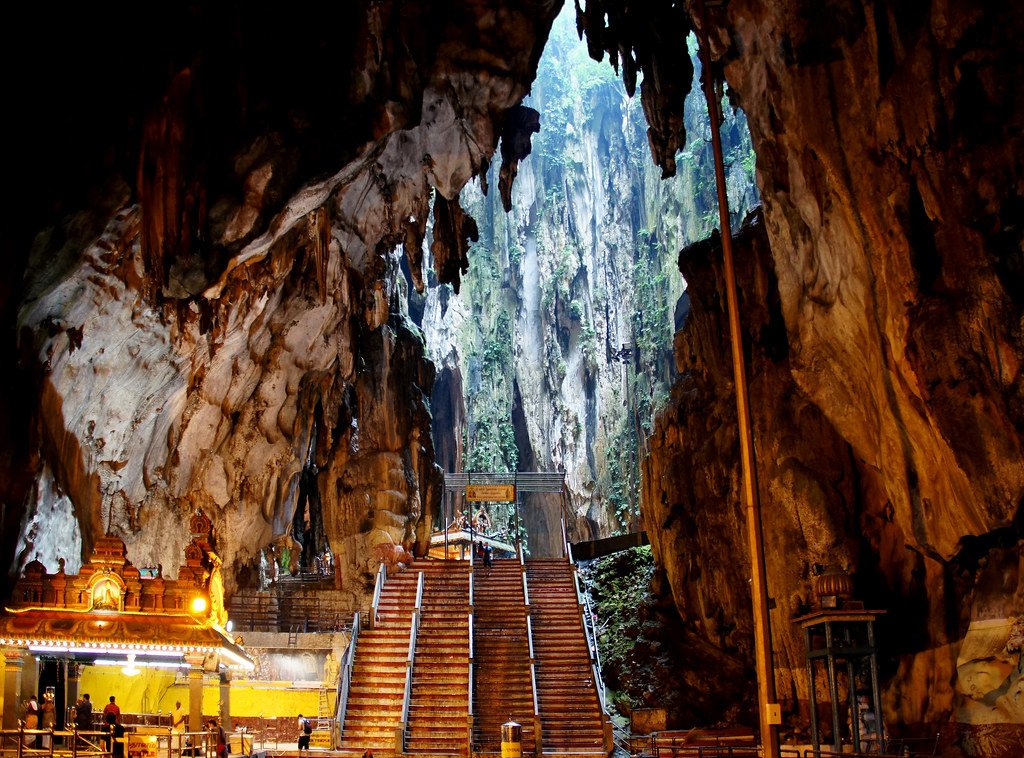
The most dramatic Hindu site in Malaysia — a series of caves in a limestone massif about 13km north of KL city centre, accessed by 272 brightly coloured steps guarded by a 43-metre gold statue of Lord Murugan. The main cave (Cathedral Cave) soars to 100 metres in height with natural skylights. The smaller Ramayana Cave and Art Gallery Cave contain elaborate dioramas depicting scenes from Hindu epics.
The Thaipusam festival at Batu Caves (January/February, date varies by lunar calendar) is one of the most extraordinary religious spectacles in Southeast Asia — over one million devotees, some carrying kavadi (elaborate metal frameworks pierced through skin as act of devotion), make the pilgrimage up the stairs. If you’re in KL during Thaipusam, it’s not to be missed.
Outside festival times, Batu Caves is still worth the visit for the dramatic limestone setting and the active shrine life within the cave. Entrance to the main cave is free. MRT to Batu Caves station (the recently opened Batu Caves MRT line makes it very accessible).
Sri Mahamariamman Temple (Jalan Bandar, Chinatown)
KL’s oldest and most ornate Hindu temple, founded in 1873 and located in the heart of Chinatown. The gopuram (entrance tower) is decorated with hundreds of deities and mythological figures in vivid colours — a feast of Hindu iconography. Inside, the main sanctum is dedicated to the goddess Mariamman. Active worship continues throughout the day — fragrant incense, flower garlands, oil lamps.
This is the chariot that processes to Batu Caves during Thaipusam. Free to enter. Respectful dress required.
Sri Kandaswamy Kovil (Brickfields)
A large South Indian Hindu temple in KL’s Little India district, dedicated to Lord Murugan. The entrance gopuram was recently renovated and is spectacular. Brickfields has several other smaller temples, shrines, and devotional shops clustered around this area — the whole neighbourhood becomes a temple precinct during Deepavali (Diwali).
Arulmigu Sri Muthumariamman Temple (Port Klang / various)
Multiple large South Indian temple complexes exist throughout the Klang Valley, each with its own community connections and festival cycles. The Malaysian Tamil community maintains a rich temple tradition — dedicated to Murugan, Ganesha, Mariamman, Hanuman, and the full pantheon of South Indian deities. Tamil Hindu temples tend to be the most visually ornate: the riot of colour, the gopurams rising above street level, the incense-thick interior sanctuaries.
Buddhist Temples in KL and Malaysia
Thean Hou Temple (Robson Hills, KL)
The largest and most elaborate Chinese Buddhist temple in Malaysia, sitting on a prominent hill with views across KL. Built by the Hainanese community and dedicated to the sea goddess Tian Hou, the six-tier temple complex also incorporates elements of Taoism and Confucianism. The upper floor pavilions look out over KL’s skyline — particularly beautiful at dusk and during Chinese New Year when the temple is ablaze with red lanterns.
Open 9am–9pm daily, free entry. Cab or Grab from Chinatown (about 10 minutes). The temple sees its greatest activity during Chinese New Year, when thousands of devotees come to pray for prosperity in the new year.
Chan She Shu Yuen Clan Association Temple (Jalan Petaling)
A Cantonese clan temple in the heart of Chinatown, established in 1906. More intimate and less touristy than Thean Hou. The courtyard architecture, ancestor portraits, and incense spirals hanging from the ceiling give a genuine sense of living Chinese Malaysian religious tradition.
Wat Chetawan (Petaling Jaya)
A Thai Buddhist temple in PJ — distinct from the Chinese Buddhist aesthetic, following Theravada tradition with Thai architectural characteristics. Monks in saffron robes, a more formal meditation atmosphere, beautiful grounds. Accessible from PJ but less visited by tourists than the central KL temples.
Maha Vihara Temple (Brickfields)
A Sri Lankan Buddhist temple established in 1894, one of the oldest Buddhist temples in KL. The architecture is Sri Lankan Theravada in style — white, elegant, different from both Thai and Chinese Buddhist aesthetics. The Wesak Day celebrations here (May, celebrating the Buddha’s birth/enlightenment/passing) are among the most significant Buddhist events in KL’s calendar.
Taoist Temples
Sin Sze Si Ya Temple (Jalan Tun H.S. Lee, Chinatown)
KL’s oldest Chinese temple, founded in 1864 by the Chinese community leader Yap Ah Loy. A Taoist temple dedicated to two deities who were historical figures rather than mythological beings. The interior is smoky, incense-heavy, and full of religious paraphernalia accumulated over 160 years. One of the most atmospheric spaces in KL — genuinely ancient feeling in a city that has torn down much of its heritage. Free to enter.
Xuan Tian Shang Di Temple (Brickfields)
A Hokkien Taoist temple in Brickfields with a striking multi-story shrine tower. Dedicated to the Dark Lord of the North (Xuan Tian Shang Di), a significant Taoist deity for the Hokkien community. The evening atmosphere — incense, oil lamps, visiting devotees — is particularly atmospheric.
Beyond KL: Notable Temples to Visit
Kek Lok Si Temple (Penang)
The largest Buddhist temple in Malaysia and one of the most impressive in Southeast Asia. Located on a hilltop overlooking Penang, the temple complex includes a 30-metre bronze statue of Guan Yin (the Goddess of Mercy), a seven-story pagoda combining Chinese, Thai, and Burmese architectural styles, and extensive grounds on multiple levels connected by covered walkways. Allow 2–3 hours.
Arulmigu Balathandayuthapani Temple (Penang Hill)
A Tamil Hindu temple on Penang Hill dedicated to Lord Murugan. The annual Thaipusam pilgrimage here (with devotees making the ascent on foot or by funicular carrying kavadi) is one of Penang’s most significant events. The hilltop location provides views over Georgetown and the Penang Strait.
Batu Pahat and Other Malaysian States
Every significant town in Malaysia has its own complement of Chinese temples, Hindu temples, and mosques. The older commercial towns of Perak (Ipoh’s old clan temples are beautiful), Johor, and Seremban have temple complexes that reflect the specific dialect group communities that built them. Temple-spotting as you travel around Malaysia adds a layer of local history and community context to any journey.
Explore Malaysia’s Cultural Heritage
Stay near KL’s temple districts — Brickfields, Chinatown, or Masjid India — to walk to Malaysia’s best places of worship. Agoda has excellent KL hotel deals.
Find Hotels →Planning a Penang temple trip? Booking.com has good coverage of Georgetown heritage hotels within walking distance of Kek Lok Si, Penang Hill, and the clan temples.
Book Penang Hotels →Research temples, check festival dates, and access UK travel resources from Malaysia — NordVPN keeps your connection secure and unrestricted throughout your travels.
Get NordVPN →Some links are affiliate links. I earn a small commission if you sign up at no extra cost to you. I only recommend things I actually use.