Let me be honest with you: I had absolutely no idea how to get around Kuala Lumpur when I first arrived.
Prices checked August 2026. Everything here is what I actually paid or was actually quoted, in ringgit, in Kuala Lumpur. Malaysia moves fast — check before you commit to anything.
I downloaded three different apps, asked a confused-looking uncle at my condo for directions, and still ended up at the wrong LRT station twice in one day. The KL transport system looks complicated on the surface. But once it clicks, it genuinely changes your life here. Getting from Bukit Bintang to KL Sentral in 12 minutes for RM1.60? That’s not bad at all.
This guide covers everything: the trains, the buses, Grab, and what to actually do when the app crashes and you’re standing on a street corner in the rain. I’ve made every mistake so you don’t have to.
The KL Transport Map: What You Actually Need to Know
KL has more rail lines than most people expect. The confusing part is that they’re run by different operators, which is why they don’t always feel seamlessly connected. Here’s a quick rundown of the main ones:
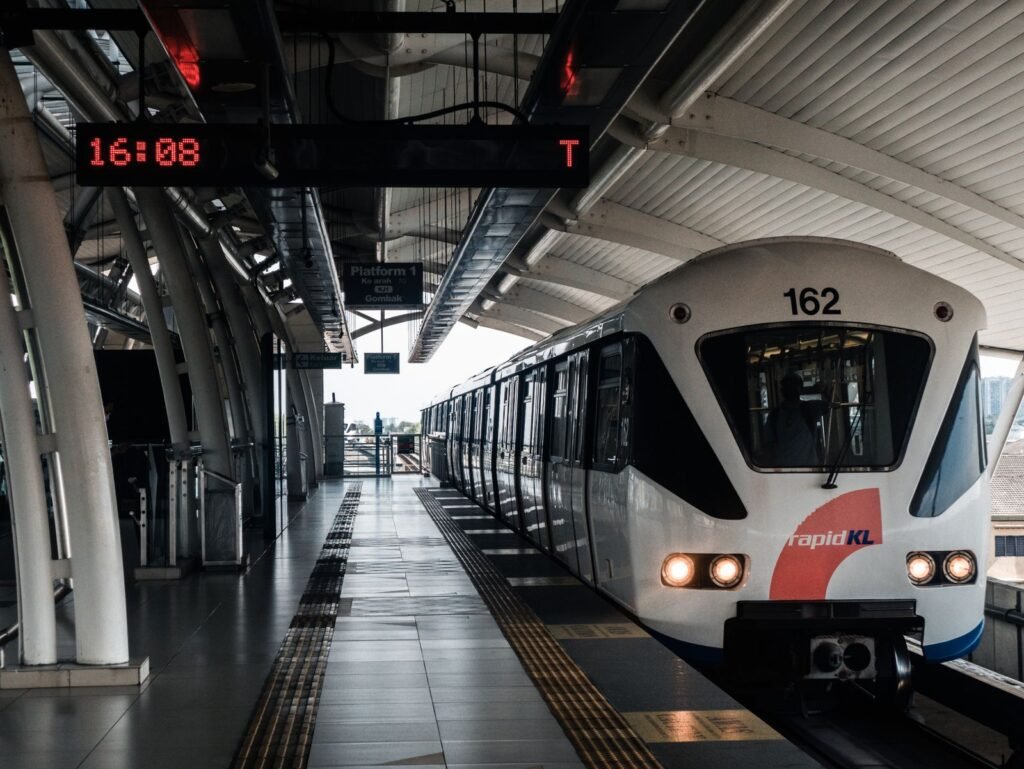
- LRT (Rapid KL) — Two main lines: the Kelana Jaya line (blue) running east-west, and the Ampang line (red). These cover a huge chunk of central KL and the suburbs.
- MRT (Klang Valley MRT) — The newer, shinier network. Two lines: Kajang line (purple) and Putrajaya line (brown). These go deep into the suburbs and are often less crowded.
- KTM Komuter — The older intercity rail. Useful for getting to places like Klang, Seremban, or if you’re heading toward the airport direction.
- Monorail — One short line that runs through Bukit Bintang, Imbi, Brickfields, and KL Sentral. Iconic. Slow. But genuinely useful for a small slice of the city.
- ERL (KLIA Ekspres) — The airport express from KL Sentral to KLIA and KLIA2. The fast way to the airport. More on this below.
The Touch ’n Go Card: Your Most Important Piece of Plastic
Stop buying single-journey tickets. Just stop. Get a Touch ’n Go card on your first or second day in KL and load it with some credit. You can use it on every rail line (except KLIA Ekspres, which has its own system), plus buses, and even in some car parks and petrol stations.
You can buy one at any LRT or MRT station counter, or at 7-Eleven. The card itself costs around RM10 (non-refundable), then you load credit on top of that. RM50 should last a solo traveller a good couple of weeks of regular travel.
There’s also the Touch ’n Go eWallet app, which lets you top up the card digitally and also works for QR payments all over the city. It’s worth having both — the physical card for tapping at stations, the app for everything else.
Getting From the Airport to KL City Centre
This is always the first question. You land at KLIA or KLIA2. Now what?
Option 1: KLIA Ekspres (Best Option)
The KLIA Ekspres train goes direct from both KLIA and KLIA2 to KL Sentral in about 28-33 minutes. It’s clean, air-conditioned, and has luggage space. Costs around RM55 from KLIA (less from KLIA2). You buy tickets at the station — don’t use your Touch ’n Go card here, it’s a separate system.
From KL Sentral you can connect to basically anywhere in the city. This is my default recommendation for new arrivals.
Option 2: Grab
Grab is Malaysia’s dominant ride-hailing app (think Uber but for Southeast Asia). From KLIA to central KL, expect to pay around RM60-90 depending on traffic and time of day. It takes 45 minutes on a good day, well over an hour during peak times. Not the best value compared to the train, but useful if you have a lot of luggage or you’re arriving late at night and your destination isn’t near KL Sentral.
Option 3: Airport Bus
There are several bus services (SkyBus, Aerobus) running between KLIA/KLIA2 and KL. They’re cheap (around RM10-15) but slow, and they drop you at specific points rather than door-to-door. Fine if you’re on a tight budget and not in a rush. Not ideal with heavy bags.
Grab: Using It Like a Local
Download Grab before you land. Seriously. It’s the transport backbone of daily KL life for expats and locals alike. You use it for:
- Rides when the train doesn’t go close enough to your destination
- Late nights when the rail network stops running (around midnight)
- When you’re carrying shopping or it’s bucketing down outside
- GrabFood for food delivery (this is huge in KL)
Payment: you can pay cash or link a card. The app works with most international cards. If you’re managing money across currencies, I use Wise for my Malaysian ringgit spending — it’s saved me considerably on conversion fees compared to using a standard UK debit card.
Getting Around by Bus
KL has a reasonably good bus network called RapidKL Bus. The routes cover a lot of ground that the trains don’t. You pay with your Touch ’n Go card, and fares are cheap — typically RM1 to RM3.
The catch: buses in KL can be slow and unpredictable in traffic. They’re worth using for short hops or when a specific route suits you perfectly. For longer journeys, the train is almost always faster.
There’s also the Go KL City Bus — a free bus service running four colour-coded routes through the city centre. It’s genuinely free. No card needed. Great for sightseeing or getting between shopping areas in KLCC, Bukit Bintang, and Masjid India without paying anything.
The KL Monorail: Quirky But Useful
The monorail runs a single elevated line through some key parts of central KL: KL Sentral, Brickfields (Little India), Hang Tuah, Imbi, Bukit Bintang, and a few others. It connects to the LRT at several points.
It’s slow and gets very crowded at rush hour, but it covers the Bukit Bintang stretch well. If you’re staying in or near Bukit Bintang and want to get to KL Sentral, the monorail is your friend. The fare is around RM1.60-2.50 depending on distance.
Navigating KL Sentral
KL Sentral is the main transport hub and it’s enormous. Every rail line connects here: LRT, MRT, KTM, Monorail, ERL to the airport. When you first arrive it can feel overwhelming.
The key thing to know: the signage is actually quite good once you slow down and read it. Follow the signs for whichever line you want. The platforms are separated but there are clear walkways between them. Give yourself extra time the first couple of times you use it and you’ll be fine.
Transport Apps Worth Having
- Grab — Ride-hailing and food delivery. Essential.
- MyRapid — Official RapidKL app for train and bus routes and journey planning
- Touch ’n Go eWallet — For topping up your TnG card and QR payments
- Google Maps — Works well in KL and shows public transport options clearly
- Waze — If you’re ever in a car. Locals swear by it.
Common Mistakes to Avoid
- Trying to buy single-journey tokens every time. Get the Touch ’n Go card. It’s cheaper and saves queuing.
- Assuming all lines connect seamlessly. Sometimes you have to exit a station, walk a minute, and enter a different one.
- Underestimating KL traffic. Getting somewhere 4km away by car can take 40 minutes during rush hour. The train is almost always faster in the city centre.
- Not downloading Grab before you land. Download it at home. Set up payment. Thank yourself later.
- Booking taxis at the airport instead of Grab. The metered taxis outside KL airport are significantly more expensive than Grab for the same journey.
A Word on VPNs and Internet on the Go
If you’re a digital nomad or remote worker using public WiFi on trains and in cafes, it’s worth using a VPN. I use NordVPN — it keeps my connection secure on public networks and occasionally comes in handy for accessing UK streaming services from KL. Sounds like a small thing but it’s one of those tools I stopped noticing until the one time I didn’t have it.
The Honest Verdict
KL public transport is genuinely good once you learn the map. It won’t blow your mind like Tokyo or Singapore, but it’s cheap, reasonably reliable, and covers most of the places you actually want to go. The LRT and MRT will become second nature within a week. Grab fills the gaps.
My typical day: walk to the LRT, tap my Touch ’n Go card, get to wherever I’m going. Grab when it’s raining or I’m carrying too much. The monorail for Bukit Bintang evenings. That’s pretty much it.
The city is very manageable once you stop trying to figure it all out at once.
📊 My KL Expat Resources
The tools I actually use day-to-day living in KL.
💰 Wise — Send Money Without the Fees
Transfer money between UK and Malaysia at the real exchange rate. Saves a small fortune versus a regular bank.
Try Wise Free →🔒 NordVPN — Secure Public WiFi
Useful on KL trains and cafes. Also lets you access UK catch-up TV and other UK services from Malaysia.
Get NordVPN →🏠 Agoda — Hotels in KL
Best prices for KL hotels and serviced apartments. Better deals than most other platforms for Southeast Asia stays.
Search Agoda →Some links are affiliate links. I earn a small commission if you sign up at no extra cost to you. I only recommend things I actually use.
KL’s Rail Network: MRT, LRT, Monorail and KTM
KL has multiple overlapping rail lines operated by different operators. It’s slightly confusing at first, but the apps make it manageable.
MRT (Mass Rapid Transit)
The MRT is KL’s newest and most modern rail system, with clean, air-conditioned, frequent trains. There are currently two lines:
Putrajaya Line (formerly SBK Line): Runs from Kwasa Damansara in the northwest through KL Sentral, Bukit Bintang, and out to Putrajaya/Cyberjaya in the south. This is the line that most expats use most often — it connects most major shopping malls, residential areas, and commercial centres. The Bukit Bintang MRT station is central for most tourist and expat activity.
Putrajaya Line Extension to Batu Caves: The extension taking the Putrajaya line through to Batu Caves opened recently, making Batu Caves much more accessible without a car.
Johor Bahru–Singapore Rapid Transit System: Not yet operational at time of writing but coming soon — connecting JB to Singapore by rail.
LRT (Light Rail Transit)
The LRT is older than the MRT but covers a wider area. Two main lines:
Kelana Jaya Line: Runs from Putra Heights through Subang Jaya and Damansara, through to KL Sentral, Masjid Jamek, and then northeast to Gombak. Useful for reaching Petaling Jaya, Subang Jaya, and areas in the northwest suburbs.
Ampang/Sri Petaling Line: Splits into two branches — the Ampang branch goes northeast, and the Sri Petaling branch goes south toward Puchong. Both pass through the city centre including Chan Sow Lin and Masjid Jamek.
KL Monorail
A short elevated monorail running through the central KL area, from KL Sentral in the south to Titiwangsa in the north, passing through Bukit Bintang and Chow Kit. Useful for moving between Brickfields, Bukit Bintang, KLCC vicinity, and Chow Kit. Trains are small and can get crowded during peak hours.
KTM Komuter
The older suburban rail network run by Keretapi Tanah Melayu (KTM). Two main commuter lines serve the Klang Valley. Trains are less frequent than MRT/LRT and the system is older, but KTM Komuter is important for reaching destinations not on the MRT/LRT network — including Klang, Port Klang, Seremban, and parts of Shah Alam.
ERL: Express Rail Link (KLIA Ekspres)
The airport express train connecting KL Sentral to Kuala Lumpur International Airport (KLIA and KLIA2). Journey time approximately 35 minutes to KLIA, 28 minutes to KLIA2. Trains run every 15–20 minutes. Price is around RM55 one-way. Strongly recommended over taxi/Grab for airport transfers — reliable, fast, no traffic.
Grab: KL’s Essential App
Grab is the Southeast Asian equivalent of Uber, and in KL it is absolutely essential. Almost everyone uses it — expats, locals, tourists. Standard Grab cars are inexpensive compared to UK taxis, clean, and the app works flawlessly. Price is shown upfront before you book.
Grab also has GrabFood (food delivery), GrabMart (grocery delivery), and other services. For transport specifically: GrabCar is the standard ride, GrabBike is motorcycle rides (fast but exposed — useful if you’re alone and it’s not raining), GrabTaxi connects you to metered taxis.
Surges happen during peak hours and rain — KL traffic can be terrible from 7–9am and 5–8pm on weekdays, and whenever it rains heavily. Budget extra time accordingly. On balance, Grab is more reliable and usually cheaper than taxis, and you don’t need to negotiate a fare.
Taxis
Traditional metered taxis still operate in KL. The red-and-white Teksi Luar Bandar taxis are the most common. Hailing a taxi on the street is possible but the meter is sometimes disputed, and some drivers quote flat rates rather than using the meter (always negotiate before getting in if using street taxis). Using Grab avoids all of this friction.
MyTeksi is a local taxi-booking app that shows licensed taxis — a middle ground between street hailing and Grab.
Buses
KL has an extensive bus network operated by Rapid KL (the bus subsidiary of Prasarana). The buses are cheap — RM1 flat fare on many routes — and cover areas not served by rail. However, the bus network is hard to navigate without local knowledge, and buses get stuck in traffic.
The most tourist-useful buses:
GoKL City Bus: A free bus service covering the city centre — four colour-coded routes connecting Brickfields (KL Sentral), Bukit Bintang, KLCC, Masjid Jamek, and Chinatown. Completely free to ride. Runs every 10–15 minutes. This is genuinely useful for getting between the main tourist areas without paying for Grab.
BRT Sunway Line: A bus rapid transit line in Subang Jaya, useful if you live in that area.
Driving in KL
Should you drive in KL? The answer depends on where you live and what you need to do.
If you live in a well-connected area (Bangsar, Mont Kiara, KLCC vicinity, Damansara Heights, Bukit Bintang) and don’t need to travel to suburban areas regularly, you can live perfectly well without a car using rail + Grab.
If you live in a less-connected suburb, work in an area not well-served by rail, have children at school, or need to carry large amounts of shopping regularly — a car becomes much more useful. Many expat families in KL own a car for these reasons.
KL traffic is brutal during peak hours. The LDP, NKVE, SPRINT, and Federal Highway get significantly congested. Highway tolls add up — budget for these if you’re driving regularly. Parking in the city centre is available but expensive at peak times.
Driving in Malaysia is on the left, same as the UK. Roads are generally good quality. Malaysian drivers can be aggressive and lane discipline is loose — allow adjustment time if you’re not used to it.
e-Scooters and Cycling
KL is not a cycling city in the European sense — traffic is heavy, pavements are inconsistent, and the heat makes cycling for any distance challenging. However, e-scooters and bikes are available via apps (Beam, Anywheel) in some areas, and cycling for recreation in parks (like Taman Titiwangsa or the KL Forest Eco Park) is perfectly pleasant.
Some suburban developments have internal cycling paths. If you’re in Putrajaya or Cyberjaya, cycling infrastructure is better than the KL city core.
Getting to and from KLIA
KLIA Ekspres (ERL): The fastest option — 35 minutes from KL Sentral to KLIA, RM55 one-way. Highly recommended.
Grab from the city: Typically RM60–100 depending on traffic and time of day, 45–90 minutes in traffic. Cheaper at off-peak times but unreliable for timing.
Taxi from the airport: Fixed-rate taxis from KLIA are available at the arrival hall. Ask for the fixed-rate taxi counters rather than accepting approaches from touts.
Getting Set Up in KL
Pay for Grab rides, top up your Touch ‘n Go card (for toll and transit), and manage your ringgit and pounds in one multi-currency account.
Get Wise →Access UK maps, use Google services without restrictions, and keep your connection secure when using public wifi on trains and at transit hubs.
Get NordVPN →When choosing where to stay in KL, pick a hotel near an MRT or LRT station to get the most out of the rail network. Agoda shows transit proximity on hotel listings.
Find MRT-Connected Hotels →Some links are affiliate links. I earn a small commission if you sign up at no extra cost to you. I only recommend things I actually use.