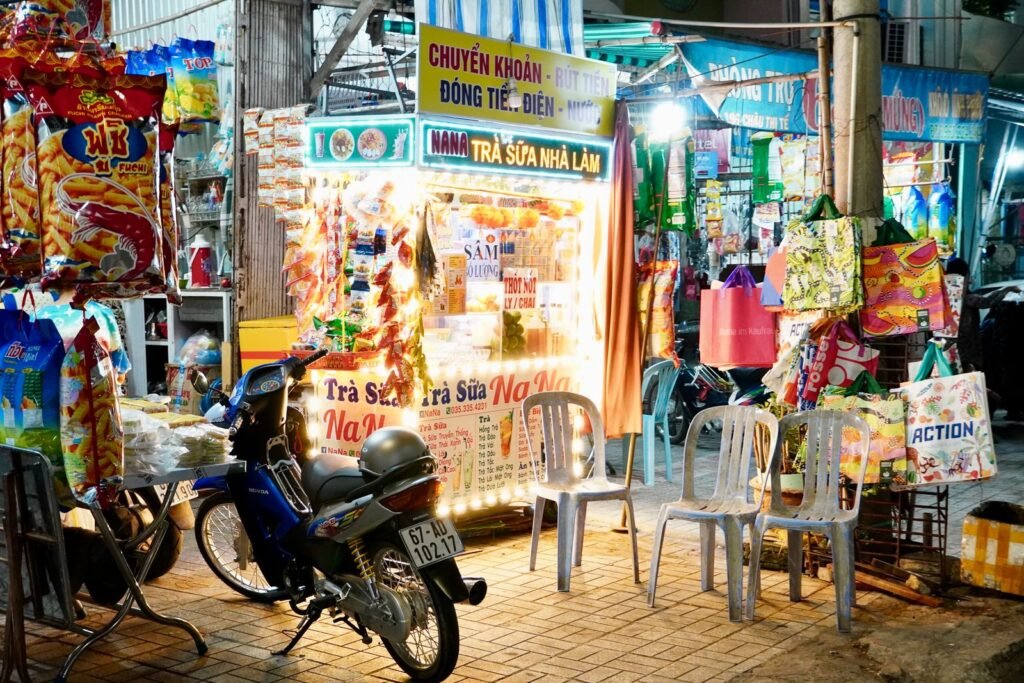
Tuesday evenings, I go to the Pasar Malam in Taman Tun Dr Ismail. I bring a small bag, about MYR 40 in cash, and an empty stomach. An hour later I head home with a stack of satay skewers wrapped in newspaper, a bag of rambutans, some freshly fried popiah, and whatever I’ve been roped into buying that I didn’t intend to — last week it was a bag of dried mango strips. Every time, it costs almost nothing and I eat better than I would at a restaurant twice the price.
Pasar Malam — literally “night market” in Malay — are one of my favourite things about living in KL. They pop up at fixed locations on specific nights each week, transforming a quiet road or carpark into a buzzing outdoor market for a few hours before vanishing. They’re hyperlocal, almost entirely cash-based, and predominantly attended by Malaysians rather than tourists. This guide tells you where to find them, what to eat, and how to make the most of them.
What Is a Pasar Malam?
A Pasar Malam is a weekly night market run by licensed vendors who set up stalls along a designated road or public space each week on the same night. They typically run from around 4pm or 5pm until 10pm or 11pm, though the best food often sells out by 8pm.
The atmosphere is relaxed and lively. You’ll hear Malay, Cantonese, Tamil, and Mandarin all in the same stretch of stalls. Kids weave through legs. Aunties push trolleys. Old uncles argue good-naturedly over the last piece of kuih. Nobody is in a hurry and nobody is trying to rip you off. The prices are set, they’re low, and the food is made fresh.
Unlike the more tourist-focused markets you’ll find in parts of Bukit Bintang or Petaling Street, most Pasar Malam in KL are residential neighbourhood affairs. You’re unlikely to find English menus or vendors who speak much beyond basic pleasantries. This is a feature, not a bug.
The Best Pasar Malam in KL
TTDI (Taman Tun Dr Ismail) — Tuesday evenings
My personal favourite and, I’d argue, one of the best Pasar Malam in KL. TTDI is an affluent, multicultural residential neighbourhood about 20 minutes west of the city centre, and the Tuesday market here is large, well-organised, and has exceptional food variety. The satay here is some of the best I’ve found at any market — properly charcoal-grilled, served with peanut sauce and cucumber. The fruit section is also outstanding.
Location: Along Jalan Tun Mohd Fuad 1, TTDI. Takes about 15 minutes on a Grab from Bangsar or Mont Kiara.
SS2 Petaling Jaya — Monday evenings
Technically in PJ rather than KL proper, but well worth the Grab ride. The SS2 Pasar Malam is massive — one of the largest in the Klang Valley — and runs along multiple streets. It’s been operating for decades and has a devoted local following. Expect everything from freshly made apam balik (crispy pancake filled with peanuts and corn) to roast duck, durian, and excellent grilled seafood. This is the one to go to if you want the full Pasar Malam experience on a grand scale.
Location: Along Jalan SS2/75, Petaling Jaya. About 20–25 minutes from central KL.
Taman Connaught — Wednesday evenings
Possibly the most famous Pasar Malam in all of KL. Taman Connaught’s Wednesday market stretches for nearly a kilometre and draws crowds from across the city. It’s been running since the early 2000s and has grown into something genuinely spectacular. The food is excellent — there are stalls here that have been at the same spot for fifteen years and have perfected their one or two dishes.
If I’m introducing someone to Pasar Malam for the first time, Connaught is where I take them. It’s enormous enough that there’s always something new to find. The downside is that it gets crowded and parking is a nightmare — go by Grab, get there by 6pm to beat the worst of the crowd.
Location: Along Jalan Cerdas, Taman Connaught, Cheras. About 25–30 minutes from central KL.
Sri Petaling — Thursday evenings
A large market in a predominantly Chinese neighbourhood south of the city. Great for Chinese-influenced food — char kway teow, roast meats, wonton noodles alongside the usual Malay night market staples. A slightly more balanced mix than some of the more Malay-focused markets, reflecting the neighbourhood’s demographics.
Location: Along Jalan Radin Tengah, Sri Petaling.
Taman Mega Mendung (Kepong) — Saturday evenings
A newer but popular market in Kepong, north of the city. Heavy on Malay food, good variety of kuih (traditional cakes and sweets), and notably less crowded than Connaught. A good option if you’re staying in the Mont Kiara or Kepong area.
What to Eat: A Pasar Malam Food Guide
The food at Pasar Malam varies by location and vendor, but certain dishes appear at almost every market:
Satay
Skewers of marinated chicken or beef, grilled over charcoal and served with peanut sauce, compressed rice (ketupat), cucumber, and onion. Buy by the stick — MYR 0.60–1.00 each. Order 10 minimum. Eat standing next to the stall. One of the finest snacks on earth.
Apam Balik
A thin, crispy pancake made in a round mould, filled with creamed corn, crushed peanuts, and sugar, then folded in half. The “crispy” version (thin batter) is better than the “fluffy” version in my opinion, though you’ll find both. MYR 2–4 each. Enormous and incredibly satisfying.
Popiah
Fresh spring rolls filled with turnip, carrots, tofu, egg, and various sauces, wrapped in a soft flour skin. Not fried — a cold roll that’s assembled to order. Light, refreshing, and different from what you might think of as a spring roll. MYR 3–5 each.
Grilled Corn
Sweet corn grilled over charcoal and rolled in a mixture of butter, mayonnaise, cheese powder, and sometimes chilli. It’s messy, delicious, and feels indulgent for MYR 4–6.
Kuih
Traditional Malaysian cakes and desserts, usually colourful and intricately made. Kuih lapis (layered jelly cake), kuih talam (pandan and coconut), onde onde (glutinous rice balls filled with palm sugar), and countless others. Usually sold in small portions for MYR 0.50–1.50 each. Buy a mixed selection — a good kuih stall will have 15–20 varieties.
Fried Stuff
Cucur udang (prawn fritters), goreng pisang (banana fritters), fried sweet potato — all the fried snacks you could want, freshly made and served in paper bags. MYR 1–3 per serving. Extremely dangerous in combination.
Durian
During durian season (roughly June–August), Pasar Malam stalls sell durian by the seed or by the whole fruit. This is one of the best places to try durian if you haven’t yet — the vendor will open one for you, and you can smell and taste before buying. Prices range from MYR 5 per seed for ordinary varieties to MYR 20–30+ per seed for premium Musang King.
Fresh Fruit
Rambutan, langsat, mangosteen, papaya, watermelon — usually sold by weight or in pre-packed bags. Quality is generally excellent and prices are much cheaper than supermarkets. A bag of rambutans for MYR 5, mangosteen for MYR 8–12 per kilo. Stock up for breakfast the next morning.
Non-Food Stalls
About a third of Pasar Malam stalls sell non-food items: clothes (often cheap copies of branded activewear), household items, toys, accessories, phone cases, and bargain bins of everything imaginable. The quality is variable and the prices are often negotiable. I usually focus on the food section but the non-food stalls are part of the atmosphere.
One exception: cleaning products, fruits, and vegetables at Pasar Malam are often genuinely better value than supermarkets. I regularly buy mangoes, papayas, and leafy greens from market vegetable vendors at half the Cold Storage price.
Practical Tips for Pasar Malam
Bring cash: Almost all stalls are cash only. MYR 40–50 is plenty for a comfortable eat through a market, unless you’re buying large amounts of fruit or non-food items.
Go hungry: This sounds obvious but the temptation to graze through ten stalls is real. Don’t eat dinner first. Markets are best experienced on an empty stomach.
Get there by 6:30pm: The best stalls sell out. Satay spots, popular kuih stalls, and durian vendors often run out by 8–9pm. Arrive early.
Go by Grab: Parking at markets is a nightmare. Grab is cheap and eliminates the stress. Drop off and pick up nearby — the driver will usually understand “Pasar Malam TTDI Tuesday” or similar.
Point and smile: If your Malay is minimal, pointing works perfectly well. Vendors are patient and used to it. “Berapa?” means “how much?” — a useful phrase to have.
Eat at the market: Most markets have a small seating area — fold-out chairs and tables near the food stalls. Use them. Eating satay while standing and watching the market bustle around you is the right way to do it.
Beyond Pasar Malam: Other KL Markets Worth Knowing
Pasar Pagi (Morning Markets): The daytime equivalent — fresh produce, meat, fish, and breakfast food, usually running from 6am to noon. The one in Chow Kit is legendary and worth getting up early for.
Jalan Masjid India: Not a Pasar Malam but a permanent stretch of market stalls in Little India, great for fabrics, spices, Indian sweets, and street food during the day and evenings.
Central Market (Pasar Seni): More tourist-facing, but a good place to find handicrafts, batik, and Malaysian art. In the Pasar Seni area of central KL.
Markets are in the blood of KL. The city was literally founded on the back of a tin market at the confluence of two rivers — “Kuala Lumpur” means “muddy estuary” in Malay, a reference to where traders gathered. The Pasar Malam tradition is newer but it carries the same spirit: a community gathering around food and trade, loud and colourful and entirely worth your Tuesday evening.
Booking.com — find hotels near KL’s best neighbourhoods
Agoda — great rates, especially in Asia
Wise — real exchange rates for spending in Malaysia